Usually, yes. That's the short answer, and it's the one most people are hoping for when they call us.
The longer answer is that it depends on how long the water sat there before anyone noticed. A ceiling that got wet yesterday and a ceiling that's been quietly dripping since the storms in early spring are two completely different jobs, even if the stain on the surface looks about the same size.
First, find out where it’s coming from
This part gets skipped constantly. Someone sees a stain, hits it with Kilz, rolls on two coats of ceiling paint, and calls it done. Three weeks later the stain is back, slightly bigger, and now there's a musty smell in the hallway.
Painting over a stain does nothing about the leak. And in older Potomac homes especially, the leak is rarely directly above the stain; water travels along joists and pipe runs before it finds a low spot to drop through. We've traced ceiling stains in first-floor dining rooms back to a toilet supply line two rooms away on the second floor.
Common culprits around here: roof and flashing issues after wind or ice; failing supply lines and drain connections upstairs; AC condensate lines that clog in July and quietly overflow the pan; tub surrounds where the caulk gave up years ago. Every once in a while it's something weird: a bathroom fan venting into the attic instead of outside, dumping humid air where it condenses on the underside of the roof deck.
If water is still actively coming in as you read this, stop and deal with that first. We wrote a separate step-by-step on what to do in the first hour after water damage, shutting off the supply, killing power to affected areas, and documenting everything before you move anything.
When the ceiling can just be dried and repainted
If the drywall is still firm when you press on it, there's no sag, and the leak got shut off fast, you're in decent shape. Dry it out properly, treat the area, seal the stain with a shellac-based or oil-based stain blocker (latex primer will let tannin bleed right through), repaint, and done.
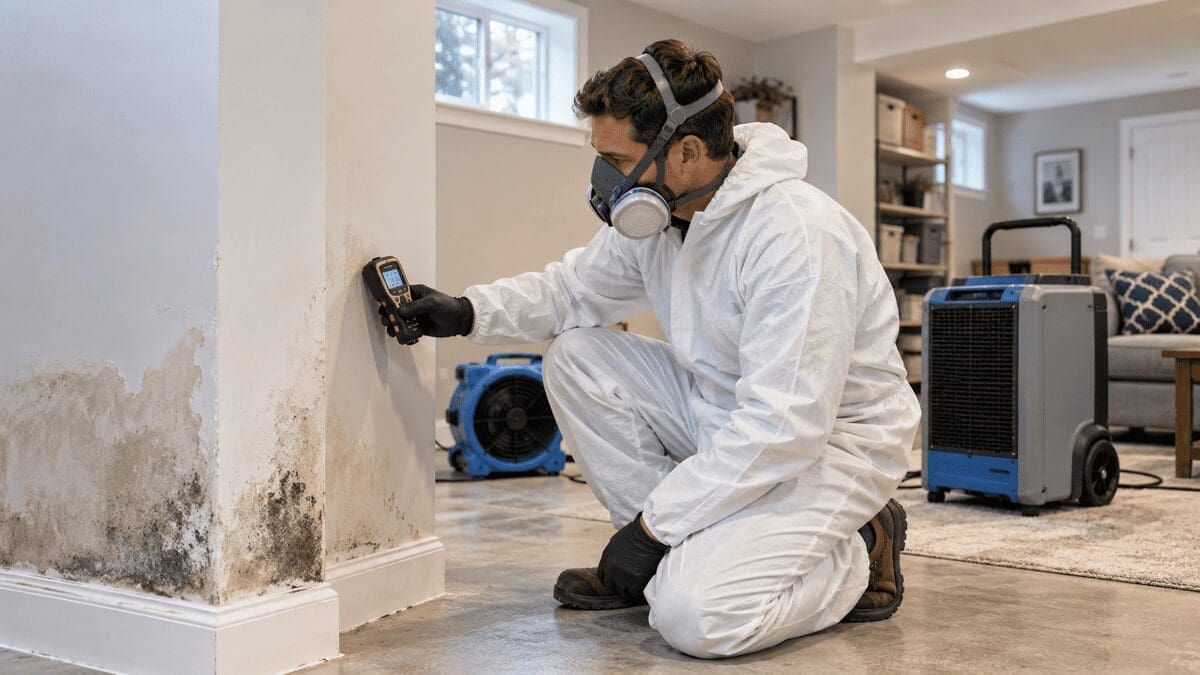
Drywall can feel dry on the surface while the paper facing and the insulation above it are still holding moisture. That's why we use moisture meters instead of going by feel and why we'd rather come back a day later to recheck than sign off early. This drying-and-stabilizing phase is technically mitigation rather than repair, and the distinction matters more than most homeowners expect, especially for insurance. We broke it down here: water mitigation vs. water restoration.
When it needs to come out
Wet drywall doesn't recover well. Gypsum absorbs water, swells, and loses the structural strength that lets a half-inch sheet span 16 inches of joist spacing while holding its own weight plus a layer of paint. Once it's been saturated for a day or two, patching over it is just putting a nice finish on a weak spot.
Signs you're past the point of patching:
It sags, bulges, or the seams have started to open up.
It feels spongy, like pressing on a wet cardboard box.
There's visible mold, or a smell that won't go away after drying.
The water's been in there longer than a couple of days
At that point the affected section gets cut out. The wet insulation above it usually comes out too, because fiberglass that's been soaked holds water against the framing for a long time and loses most of its R-value anyway. Then the framing gets dried and checked, and new drywall goes up after, not before, the cavity reads dry. Our water damage restoration and mitigation crews handle the drying and the rebuild as one job, which means nobody's waiting on a second contractor to close the ceiling back up.
That sequence matters more than anything else in this article. Closing up a wet cavity is how you end up with a mold problem inside the ceiling you can't see, which is a much worse and much more expensive situation than the stain you started with.
If you already smell mold
A musty odor coming from a ceiling cavity usually means growth has started somewhere you can't see it, and that changes the scope of the job. Ceiling cavities are dark, unventilated, and full of paper-faced drywall and organic dust—good conditions for it. Cutting into that without containment spreads spores through the rest of the house, so it gets handled as mold remediation, not a drywall repair. If you're trying to gauge what that runs, we published a cost breakdown for Gaithersburg homeowners.
What about textured or Plaster Ceilings?
Popcorn and knockdown textures make matching harder but not impossible; the patch gets sprayed and knocked down to blend. Worth knowing: if the ceiling texture predates the mid-1980s, have it tested before anyone starts scraping. Some of it contains asbestos, and homes from that era often have lead paint in the layers underneath as well. Either one changes the whole approach.
Older plaster-and-lath ceilings are their own thing. Plaster can sometimes survive a wetting better than drywall, but once the keys break loose from the lath, the plaster starts separating from the substrate, and there's no reattaching it. If it's crumbling or you can see it bellying away from the ceiling above, treat it as an urgent structural concern, not a cosmetic one.
Don’t wait it out
The most expensive ceiling jobs we do are almost always the ones where someone watched a small stain for a few months to see whether it would get worse. It did. The repair that would have been a two-foot patch turned into replacing a section of ceiling, part of a wall, and the insulation above both.
If you've got a stain, a soft spot, or a ceiling that's started to bow anywhere in Gaithersburg, Potomac, or the surrounding Montgomery County area, get eyes on it while it's still small. We'll tell you honestly whether it's a dry-and-repaint situation or something bigger; sometimes the answer really is that you got lucky.
ManyWays LLC is licensed and insured in Maryland (MHIC #150485), we take emergency calls, and we work with most insurance carriers. Request a free estimate or call (301) 605-2296.
Get Emergency Help Now
24/7, emergency calls answered after 8 PM ✉️ sales@mwhi.net 📍 802 Flagler Dr. Gaithersburg, MD 20878
Turn Your Basement Into a Space You’ll Love
A well-designed basement can add valuable living space to your home. From cozy family rooms to modern home offices or entertainment areas, smart basement remodeling ideas help maximize functionality, comfort, and style while increasing your home’s overall value.